
Wildwood Park & Zoo Welcomes Two Long-Awaited Cougar Cubs
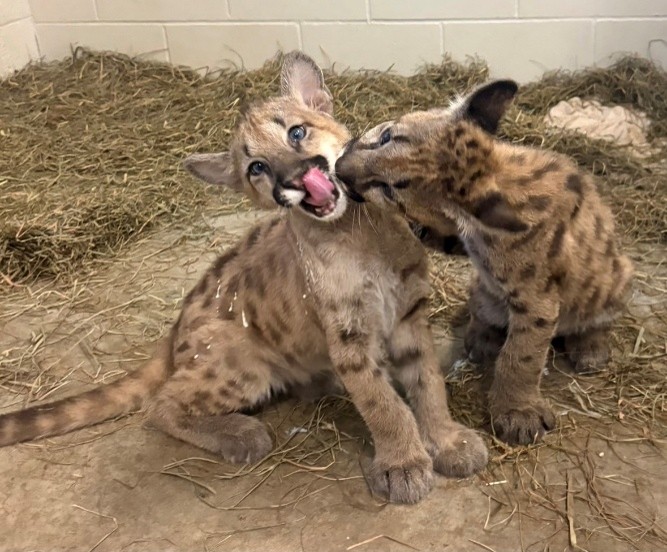
MARSHFIELD, Wis. — Wildwood Park & Zoo has welcomed two new cougar cubs, an unrelated young male and a young female, who will become the newest animal ambassadors at the City of Marshfield's zoo. Both are around three months old and still very reliant on their support staff.
The cubs arrived last week from a Wisconsin-based captive breeding facility and are settling into their new home. Both are eating well, playing with enrichment items and becoming increasingly comfortable with their surroundings.
While the community is understandably excited to meet Wildwood's newest residents, zoo staff are asking visitors for a little patience.
The zoo's Welcome Center is temporarily closed to provide the cubs with a quiet environment during their initial acclimation period. Over the coming weeks, animal care staff will gradually introduce them to new sights, sounds, and people before allowing them to begin exploring their outdoor habitat.
Once the cubs are introduced to the exhibit, visitors are encouraged to approach quietly and allow the animals to become comfortable with their new surroundings at their own pace. While the cubs don't have public names yet, that won't be the case for long. Wildwood Park & Zoo will soon announce a community naming contest.
Continuing the Legacy of Star and Thunder
The arrival of the cubs begins a new chapter in a long history of cougars at Wildwood Park & Zoo.
Many longtime visitors will remember Star and Thunder, the brother-and-sister pair that arrived at Wildwood in 2008. In 2019, the pair moved into an expanded cougar exhibit featuring additional space, natural surfaces and greater opportunities for animal enrichment and public viewing.
Thunder died in February 2024 at nearly 16 years old. Star remained at Wildwood until her death in April 2026 at age 17, just months short of her 18th birthday. During their many years at Wildwood, Star and Thunder became favorites of visitors and staff and helped introduce generations of families to one of North America's most impressive native predators.
The two new cubs will continue that legacy while giving visitors the unique opportunity to watch them grow, mature, and develop over the coming years.
Why Cougars Live at Wildwood Park & Zoo
Cougars (Puma concolor), also commonly called mountain lions or pumas, are wild animals. The two new Wildwood cubs, however, were born under human care and were not raised by a wild mother to survive independently. They are not candidates for release into the wild.
In nature, young cougars remain with their mother for an extended period while learning essential survival behaviors, including hunting, navigating large territories, identifying threats, and avoiding people. Those are learned behaviors that cannot simply be recreated by placing a captive-born animal into a natural environment.
Releasing an animal that has spent its life in human care would not necessarily give it a better life. Without the necessary survival skills and natural avoidance of people, release could place both the animal and the public at risk.
At Wildwood, the cubs will instead have a permanent home where they will receive appropriate nutrition, veterinary care, enrichment, shelter and daily care from trained staff. They can live out their lives while also serving an important educational purpose.
For thousands of visitors, particularly children, seeing a cougar up close can create a connection to wildlife that photographs and videos cannot fully duplicate. The animals provide opportunities to teach visitors about predator-prey relationships, habitat, wildlife biology, conservation, and how people can responsibly coexist with native wildlife.
Wildwood's role is therefore twofold: to provide lifelong, professional care for animals that depend upon humans while giving those animals an important role in educating future generations about wildlife and conservation.
A Native Wisconsin Species
Cougars are native to Wisconsin and historically occurred throughout the state. Wild cougars disappeared from Wisconsin by approximately 1910. Today, confirmed cougars occasionally travel through Wisconsin, but the Wisconsin Department of Natural Resources says there is currently no evidence of a breeding population in the state. The animals documented here are believed to be primarily transient males dispersing from western populations, particularly from the Black Hills of South Dakota.
There are indications, however, that the species' presence in portions of the Upper Midwest is changing. In Michigan's Upper Peninsula, two wild cougar kittens were documented in 2025—the first verified reproduction in Michigan in more than a century. Later photographs confirmed the two juveniles traveling with an adult female.
In spring 2026, trail cameras in northern Minnesota documented a female cougar with three kittens, providing the first confirmed evidence of wild cougar reproduction in Minnesota in more than 100 years. Minnesota wildlife officials cautioned that the discovery does not yet establish a self-sustaining breeding population, but it represents a significant development for the species in the Upper Midwest.
Wisconsin continues to receive occasional verified sightings as well. Most recently, the Wisconsin DNR verified a cougar captured on a trail camera in southern Lincoln County on August 12, 2026.
About Cougars
Cougars are the largest wildcat native to Wisconsin and one of North America's largest native cats. According to the Wisconsin DNR, adult males typically weigh 116 to 160 pounds, while adult females generally weigh 75 to 110 pounds. An adult cougar can measure more than 7 feet from nose to the end of its long tail.
Young cougars have distinctive spots that help provide camouflage. Those markings gradually disappear as the animal matures, leaving the tawny coat associated with an adult cougar.
Despite their size and strength, cougars are generally secretive and solitary animals. They are ambush predators, and white-tailed deer are an important natural prey species. In the wild, cougars occupy large territories and generally avoid people.
Unlike African lions, cougars cannot roar. They communicate through a range of vocalizations, including purrs, chirps, growls, hisses, and distinctive high-pitched calls.
Cougars typically live longer under professional human care than in the wild, where they must contend with injury, disease, competition, food availability, and other natural risks. Star and Thunder's long lives at Wildwood are examples of longevity that is possible with professional care.
A New Generation at Wildwood
Zoo staff will continue to closely monitor the cubs as they become accustomed to their new environment. Even after the outdoor habitat opens, visitors should remember that the animals will be able to choose where they spend their time. At times, they may choose to remain inside or in less visible areas to visitors.
The addition of the young cougars supports Wildwood Park & Zoo's mission of connecting people with wildlife through education, recreation, and conservation. They will provide an opportunity to learn not only about cougar biology and behavior, but also about the species' history in Wisconsin and its changing presence across the Upper Midwest.
The City of Marshfield Parks and Recreation Department looks forward to introducing the cubs to the community in the coming weeks.
And stay tuned; the Wildwood Park & Zoo cougar cub naming contest is coming soon!
About Wildwood Park & Zoo
Wildwood Park & Zoo is operated by the City of Marshfield Parks and Recreation Department and provides residents and visitors with opportunities to experience and learn about native and other wildlife. Admission to the zoo is free. Donations help support animal care, exhibits, educational programming, and the zoo's continued operation.
Visitors are encouraged to consider donating during their next visit to help support Wildwood Park & Zoo and its animals.