
Marshfield Utilities Commission Debates Dark Fiber Policy, Honors Longtime Employee
By David Ballerstein - Marshfield Now!
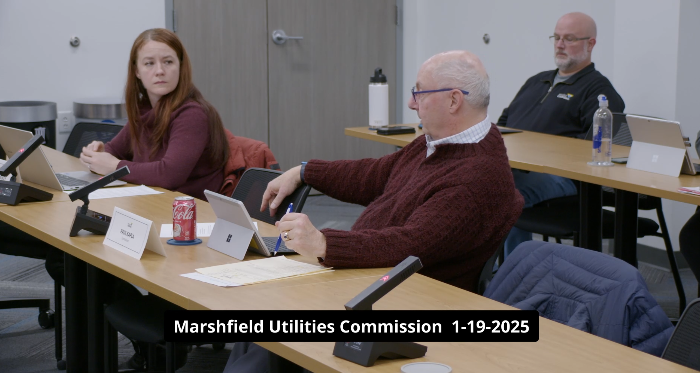
MARSHFIELD — The Marshfield Utilities Commission met Monday afternoon to discuss governance issues ranging from dark fiber pricing policy to leadership succession planning, while also recognizing a longtime employee and approving several infrastructure projects.
The meeting opened with routine business, including roll call and confirmation that proper public notice had been given. No members of the public were present for the public comment period
Employee Recognition
Commissioners recognized Erick Boon, assistant water manager, for reaching a milestone 25 years of service with Marshfield Utilities. Bloom has spent his entire career with the utility in the water department and was acknowledged for his long-term contribution to the organization
Dark Fiber Policy Discussion
A significant portion of the meeting focused on continued discussion of a draft governance policy for the utility’s dark fiber network. Utility staff presented a market rate analysis prepared by a consultant, which concluded that Marshfield Utilities’ current fiber rates are generally reasonable compared to other public entities nationwide, though direct comparisons are difficult due to differing services and market conditions
Commissioners examined how fiber capacity is used, noting that less than 25 percent of available strands are currently in service, leaving substantial excess capacity. Staff explained that customers typically lease two to four strands and that pricing is based on distance and strand count, with a separate flat administrative fee to cover billing and staff time
The commission debated whether future rate-setting should rely on market comparisons, a rate-of-return model, or a simpler approach tied to maintaining a targeted cash reserve. Several commissioners expressed concern that focusing too heavily on market rates could lead to prolonged uncertainty, while others emphasized the importance of ensuring the utility remains financially robust without overaccumulating reserves
Ideas discussed included:
Establishing a cash reserve target, such as 1.5 times annual plant value.
Creating a commission-designated fund to support community or infrastructure projects.
Exploring, but not committing to, tiered pricing for tax-funded entities versus private customers.
No formal action was taken, with staff directed to return next month with a streamlined policy draft focused primarily on cash reserve targets and oversight rather than detailed rate formulas
Succession and Contingency Planning
Commissioners also addressed general manager succession and contingency planning, prompted by results from a recent commission self-evaluation. The discussion centered on short-term contingencies — such as how operations would continue if the general manager were suddenly unavailable — rather than long-term succession alone
Staff noted that an interim general manager policy already exists but is minimal. Commissioners expressed interest in strengthening documentation around day-to-day operational continuity, leadership responsibilities, and major project oversight, while avoiding overly complex new policies. Staff indicated updated drafts would be brought forward for future review
Performance Metrics and Infrastructure Approvals
The commission reviewed quarterly key performance indicators, noting a higher-than-usual employee turnover rate in 2025 and a slight decline in public communication reach compared to 2024, largely attributed to the absence of anniversary-related outreach seen the previous year
Commissioners approved three job orders, including:
Continued conversion of high-pressure sodium streetlights to LED fixtures,
An underground electric conversion project on South Apple Peach Street,
An underground project from Felker Avenue to Hemlock Street.
Staff reported that more than 1,300 LED streetlights have already been installed citywide, with additional replacements planned in 2026
Closed Session
The meeting concluded with a vote to enter closed session under state law to discuss property matters and power purchase agreements