
Marshfield Council to Begin Budget Review, Consider Housing Redevelopment and Camping Ordinance
MARSHFIELD — The Marshfield Common Council will begin its fall budget review Tuesday, Oct. 13, with an evening that also includes discussion of affordable housing, firefighter equipment, traffic signals and a proposed ordinance restricting camping outside designated areas.
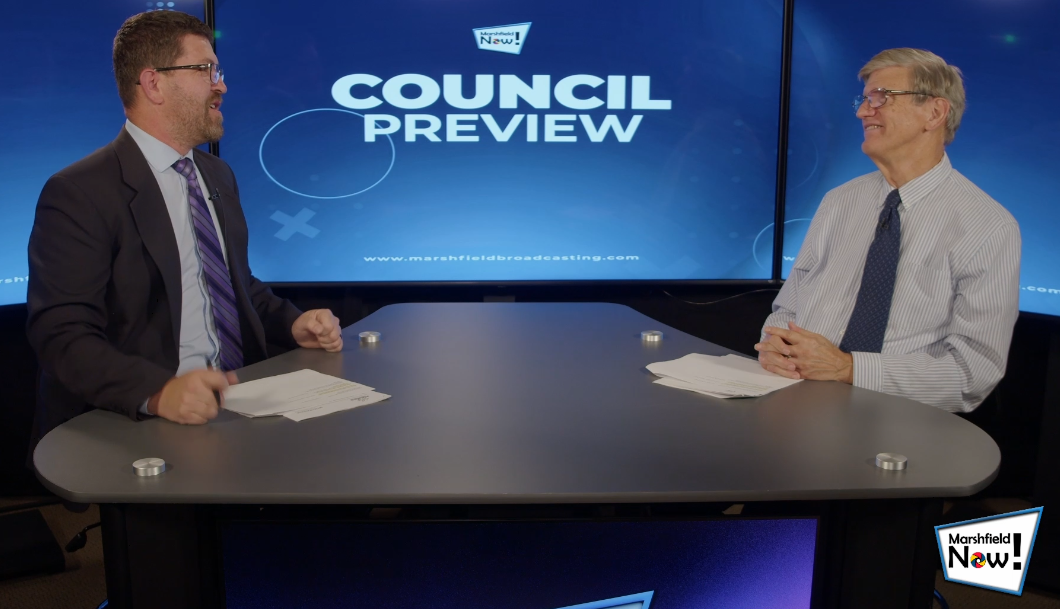
During Marshfield Broadcasting’s Council Preview, City Administrator Steve Barg joined host David Murchland to discuss the upcoming agenda. Barg said the first budget meeting will begin at 5 p.m., followed by the regular council meeting at 7 p.m.
The budget session will introduce the city’s revenue and expense outlook, highlight major issues and outline decisions council members will face during the four-meeting review process.
Residents will have an opportunity to speak during public comment, with up to five minutes at the podium. Barg encouraged people to share their priorities and concerns, even if they do not have a detailed financial solution.
Council members also will consider changes to the budget calendar. The proposed revisions would move the third budget meeting from Oct. 26 to Tuesday, Oct. 27, at 5 p.m., and the fourth meeting from Oct. 28 to Thursday, Oct. 29, at 6 p.m.
Barg said the final session would allow council members to address remaining adjustments before moving toward the public hearing and budget adoption later in the fall.
A proposed redevelopment of the former Weinbrenner building at 305 W. Third St. is another item on the regular meeting agenda. Barg said the project could create up to 83 affordable apartments, depending on its feasibility.
The council will consider a memorandum of understanding with Milwaukee-based Jeffers & Co. that would help the developer move forward with applications for historic and low-income housing tax credits.
According to Barg, the proposed agreement would commit the city to contributing up to $100,000 toward predevelopment expenses, while the developer would cover the larger share. A final development agreement would require additional work, and a potential transfer of the building for $1 remains part of the anticipated arrangement.
Barg said a preapplication is due Nov. 2, followed by a final application in February 2027. Missing that cycle could delay the project another year.
The council also is scheduled to take up the second reading of an ordinance prohibiting camping outside designated areas. Barg said the discussion grew partly from questions about someone living in a vehicle on a city street and broader concerns about extended stays on public property.
The proposal was first discussed Sept. 22. The revised draft includes a one-year sunset provision, meaning the ordinance would end unless the council takes action to renew it.
Barg said additional changes could be made before the meeting. He also acknowledged the importance of helping people find suitable housing while addressing concerns about people living on city property.
For the fire department, council members will consider authorizing an Assistance to Firefighters Grant application to replace aging self-contained breathing apparatus.
Barg said the equipment is approaching the end of its approximately 15-year lifespan, with replacement costs potentially reaching roughly $500,000. He said a successful grant application could cover 95 percent of the cost, leaving the city responsible for 5 percent.
The grant is competitive, and funding is not guaranteed. Barg said the Finance, Budget and Personnel Committee has supported pursuing the application.
Traffic signal timing also will be discussed as the city considers seeking proposals for traffic modeling and analysis. Barg said the work could help improve coordination among signals on streets including Central Avenue, Veterans Parkway, Oak Avenue and Peach Avenue.
The analysis could identify timing adjustments and locations where changes to left-turn signals would improve traffic flow.
Another proposed resolution would advance planning for a power generation project involving Marshfield Utilities and Great Lakes Utilities. Barg said the proposed ownership structure would give Great Lakes Utilities a 70 percent share and the city, through Marshfield Utilities, a 30 percent share.
A site in the newer portion of the industrial park is under consideration. Barg described the resolution as a planning checkpoint that would authorize continued negotiations, with additional city approvals still needed. He said the facility might be completed in 2029 or 2030.
Council members also will revisit the city’s public comment policy, particularly restrictions on remote and written comments being presented during meetings.
Barg said a recently adopted policy allows speakers to provide their names and addresses to the clerk before the meeting without announcing that information publicly at the podium. Further discussion will address whether other provisions are too restrictive and how presentation materials should be submitted in advance so they are available to the public.
Other agenda items include a report from Visit Marshfield on the Hub City Summer Concert Series and Maple Fall Fest, information about the costs and benefits of a citywide staffing study, and a comparison of Marshfield’s municipal tax rate with other communities.